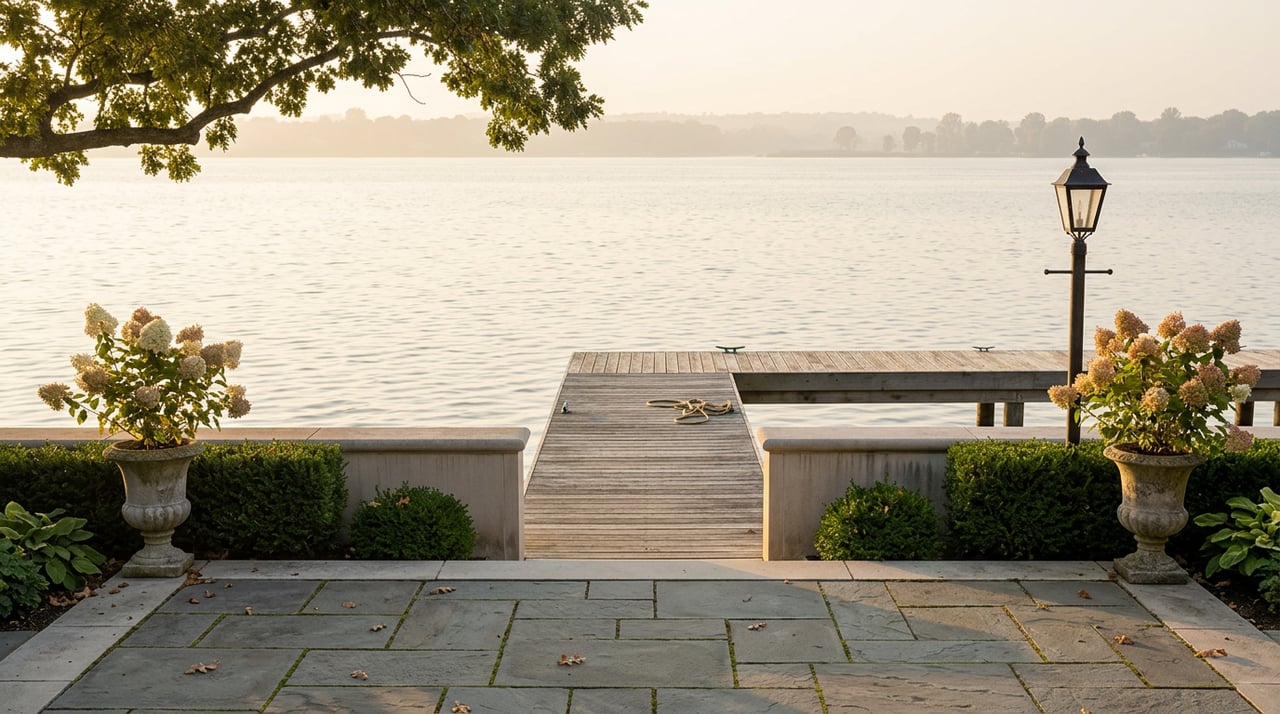
What Grosse Pointe Shores Waterfront Home Prices Miss
August 20, 2026
August 20, 2026
Buy a lakefront house on Lake Shore Road and you will, at some point, assume the dock is yours the way the kitchen is yours. It is not, not entirely. Under Michigan law, the state holds the bottomlands of the Great Lakes in trust for the public, below what regulators call the ordinary high-water mark. What a Grosse Pointe Shores homeowner actually holds is a permit, and in many cases a separate conveyance from the state, a lease, deed, or agreement that grants the right to keep a dock, seawall, or boat hoist sitting on land the homeowner does not technically own.
Here is the part that catches buyers off guard. That conveyance does not travel with the deed the way a garage or a fence line does. When the upland property changes hands, Michigan's Department of Environment, Great Lakes, and Energy requires the new owner to formally apply for a transfer or assignment of the existing conveyance through the state's MiEnviro Portal, with proof of ownership attached. Skip that step and the new owner is, on paper, occupying state trust land without authorization, even if the dock has been sitting in the same spot since the Ford administration.
For a market where the entire appeal is the water, this is not a footnote. It is the first question a serious buyer should ask before writing an offer, and the first thing a seller's agent should have ready before a showing.
The legal mechanism is called Part 325, Great Lakes Submerged Lands, part of Michigan's Natural Resources and Environmental Protection Act. It requires a permit for almost anything built on or over the bottomlands: dredging, fill, docks, boat lifts, seawalls. Some of those structures also require a separate bottomland conveyance because they occupy state property rather than simply touching it. Applications for both permits and conveyances run through the same joint system EGLE shares with the Army Corps of Engineers, and a conveyance can take a while to process, in some cases more than a year, according to the state's own guidance for property owners.
None of this is unique to the Shores. Every Grosse Pointe community with lake frontage deals with it, along with St. Clair Shores, Harrison Township, and every other Lake St. Clair address. What makes it matter more here is how concentrated true lakefront ownership is on this particular stretch of shoreline.
Grosse Pointe Shores is the smallest of the five Grosse Pointe communities, and its identity is built almost entirely around Lake Shore Road, the string of estates that runs along the water past the Edsel & Eleanor Ford House and the Grosse Pointe Yacht Club. Osius Park, the community's public waterfront green space, gives residents marina access and lakefront gathering areas, but the private frontage along Lake Shore Road is where the real estate story lives. Lots here run large, setbacks are generous, and many of the docks and seawalls in place today were built decades ago, under permitting rules that have been rewritten more than once since.
That combination, old infrastructure and a legal requirement to formally transfer the right to keep it, means Shores transactions can involve a permit question worth checking as part of the transaction.
Here is where the market data gets interesting, and where a portal median actively misleads a shopper.
In the first half of 2026, only three lakefront properties closed in Grosse Pointe Shores. Three. Not three hundred. The average closing price across those three was $2,883,000, with a median of $2,300,000. Price per square foot averaged $416 and came in at a median of $443, the highest of any Lake St. Clair waterfront community tracked for the period.
Compare that to St. Clair Shores, the most liquid canal market on the lake. Twelve waterfront and canal properties closed in the same window, averaging $634,000 with a median of $575,000. Price per square foot landed at $299 average and $300 median, a spread so tight it tells you the canal market is pricing consistently across a wide range of homes.
That contrast is the whole point. A market that closes twelve sales in six months produces a median you can actually lean on. A market that closes three produces a median that is really just a description of which three houses happened to sell, not a signal about value. If the next closing on Lake Shore Road happens to be a modest cottage-style lot instead of a grand estate, the median for the back half of 2026 could swing by hundreds of thousands of dollars without the underlying market moving at all.
Price per square foot holds up better under that kind of thin volume, because it normalizes for the fact that a 3,000 square foot lakefront home and a 9,600 square foot one are not the same asset even when they are three doors apart. That $416 to $443 range is a more honest read on what buyers are actually paying for true Shores frontage than either the average or the median closing price on its own.
The four communities that make up the Lake St. Clair waterfront tier each play a different role, and none of them should be read through the same lens.
The headline sale of the first half of 2026 was 15410 Windmill Pointe Drive in Grosse Pointe Park, which closed at $4,250,000 on 9,600 finished square feet. It sits just south of the Shores on the same lake, and it illustrates how a single large closing can pull a small-sample average in a direction that has nothing to do with where the broader market is heading. That is exactly the trap a median-price shopper falls into when they treat any of these numbers as gospel rather than as a description of a handful of specific houses.
Before a buyer submits an offer, or a seller accepts one, on Grosse Pointe Shores waterfront, four questions belong on the table:
Does the parcel have an active EGLE permit and, if applicable, a bottomland conveyance covering the dock or seawall. Has that conveyance ever been formally transferred to the current owner, or has it been sitting unassigned since an earlier sale. If a seawall was built or repaired recently, does it meet current minor permit criteria? Permits: What's Up With EGLE Permits? Part IV says many projects now require a buffer strip of at least six feet of no-mow or native planting above the wall. And how long has the current owner actually held the property, since a longer hold often means an older conveyance that has never been tested through a transfer.
None of these questions should derail a good house. They should shape the timeline. A buyer who assumes the dock transfers automatically at closing, the way a refrigerator does, can find themselves months into ownership before realizing the paperwork was never filed.
The lesson from six months of Lake St. Clair closings is not that Grosse Pointe Shores is overpriced or underpriced. It is that the market is too thin to summarize with a single number pulled from a listing site. Three sales is an anecdote wearing a statistic's clothes. The permit and conveyance question is the same story from a different angle: a piece of the transaction that never shows up in the comps but changes what a buyer is actually agreeing to own.
If you are pricing a Shores listing, considering an offer on Lake Shore Road, or trying to figure out what a specific stretch of frontage is actually worth once the dock and the paperwork behind it are accounted for, that is exactly the kind of read a portal cannot give you. Closing and Toasting works this market house by house, not median by median.
Does every waterfront home in Grosse Pointe Shores need a state conveyance, not just a permit? Not every structure requires a separate conveyance. According to The Inland Lake Owner's Field Guide to EGLE Permit Levels, many docks and boat hoists for private residential use fall under EGLE's minor project permit category. Conveyances become relevant when a structure or use occupies the state-owned bottomland itself, such as certain seawalls, fill, or larger private facilities. The distinction is worth confirming parcel by parcel rather than assuming either way.
How long does a conveyance transfer actually take? The state's own guidance notes the process can run beyond a year in some cases, since it can involve a public notice period, a site inspection, and an appraisal to set any applicable fees. That is a real timeline consideration for anyone hoping to close and immediately start using or modifying existing waterfront structures.
Does this affect homes on the canal side of the lake the same way? The same Part 325 framework applies anywhere on Great Lakes bottomlands, so canal-adjacent communities like St. Clair Shores deal with the same permitting structure. The difference in the Shores is less about the law and more about how much of the local inventory sits on older, unreviewed conveyances tied to decades-old construction.
This article is general information, not legal, tax or financial advice. Consult a qualified professional about your situation.
Buying a home will likely be one of the most expensive purchases of your life and selling your home can be an incredibly emotional experience. When you're making a tough life decision like this, it's imperative that you're working with someone you can depend on, who will be available at a moments notice, and who puts you first.